
Following on from my last two Blogs, in this Blog I set out what the current body of Intensive Interaction research actually tells us. Read on for more …
Category Archives: Other Significant Research Summaries
Intensive Interaction research: What does ‘Google A.I.’ say?

Following on from my last Blog on Intensive Interaction research, I thought I’d go all 21st century and ask Google A.I. what it thinks about the current body of Intensive Interaction research. Read on for more …
The physical and mental health benefits of touch … a research review
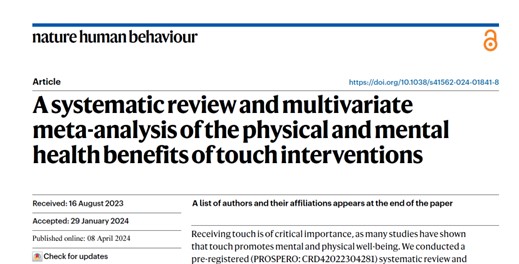
This Blog reports the results of a systematic research review into ‘the physical and mental health benefits of touch interventions’. Read on for more…
‘Staff experience of the implementation of Intensive Interaction within their places of work …’

Having re-read a paper on ‘Staff experience of the implementation of Intensive Interaction’ I set out how it fits with the theory of organisational change … read on for more.
Staff experience of the implementation of Intensive Interaction within their places of work with people with learning disabilities and/or autism

For my Blog this week I am summarising a 2021 paper collating data from a number of papers about staff’s views on implementing Intensive Interaction. To read on, follow the link…
‘Mothers’ experience of Intensive Interaction’ – a research paper

Given my current interest in the parental view of Intensive Interaction, for my Blog this week I am posting a summary of a research paper into ‘Mothers’ experience of Intensive Interaction’. Follow the link to access the summary …
‘Intensive Interaction: an evaluation of two different recording formats’

‘Intensive Interaction: an evaluation of two different recording formats’ – a study looking at the introduction of two different Intensive Interaction paper recording systems in a UK special school. Read on for more…
Staff experience of the implementation of Intensive Interaction within their places of work with people with learning disabilities and/or autism

Follow the link above to an accessible summary of the paper: Berridge, S. & Hutchinson, N. (2021) ‘Staff experience of the implementation of Intensive Interaction within their places of work with people with learning disabilities and/or autism’, Journal of Applied Research in Intellectual Disabilities – DOI: 10.1111/jar.12783
A glossary of useful research terms
BASELINE PHASE: a baseline phase is the period in research before a new approach (intervention) is started. BASELINE ASSESSMENT: a baseline assessment is an assessment of someone’s skills or competences prior to the start of an intervention in order to be able to objectively evaluate the effects of the intervention. DATA: information gathered and organisedContinue reading “A glossary of useful research terms”
Some other Intensive Interaction articles & papers of interest:
Barber M. (2007) ‘Imitation, interaction and dialogue using Intensive Interaction: tea party rules’, Support for Learning, 22, 124–30. Firth, G. (2006) ‘Intensive Interaction: a Research Review’, Mental Health & Learning Disabilities Research and Practice, 3 (1), 53-58. Firth, G., Poyser, C. & Guthrie, N. (2013) ‘Training care staff in Intensive Interactions’, Learning Disability Practice, 16Continue reading “Some other Intensive Interaction articles & papers of interest:”
 Connecting with Intensive Interaction