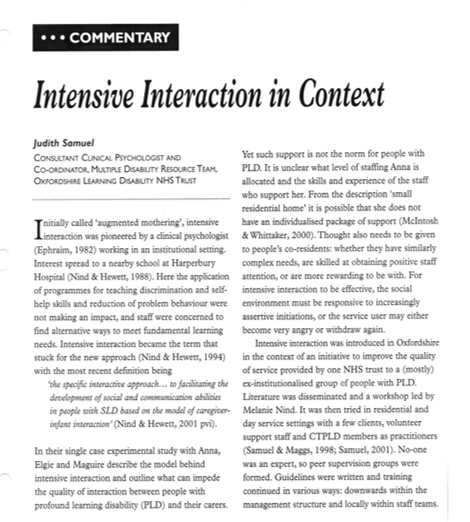
It has been 25 years since Dr Judith Samuel (then Consultant Clinical Psychologist at Oxfordshire Learning Disability NHS Trust) published her paper on introducing Intensive Interaction practices into residential care services for adults with profound intellectual disabilities in Oxfordshire (published in the Tizard Learning Disability Review, 2001, Vol 6(3), p. 25-30).
Intially referencing the socially interactive approach that was ‘pioneered’ by clinical psychologist Dr Geraint Ephraim (‘Augmented Mothering‘), and acknowledging the input of Intensive Interaction originator Melanie Nind in giving workshops on the approach, Judith’s article sets out how ‘Intensive interaction was introduced in Oxfordshire in the context of an initiative to improve the quality of service provided by one NHS trust to a (mostly) ex-institutionalised group of people with PLD [Profound Learning Disabilities]’. This was ground-breaking work!
Judith’s article lists a growing evidence base for Intensive Interaction even then (in 2001), and then goes on to set out how the approach was introduced, this being: ‘introductory training is offered, guidelines are available, the use of written and video records is encouraged and regular peer supervision groups are held’ – a model that surely still looks like ‘best practice’ 25 years later.
Interestingly, I think her conclusions are also still relevant now; these being:
‘Intensive Interaction is a simple idea, yet requires skilled reflective practice to achieve success. Factors that appear to influence progress include the context, the skill of practitioners and the training, support and supervision they receive, the frequency of sessions, the duration of the intervention and personal variables in the service user, including diagnosis, history and severity of disability.
The challenge remains of how the impact of Intensive Interaction can be measured and … maintained for people with PLD living in community settings supported by low-paid staff working irregular shifts, with little time for monitoring and reflection.’
Still useful food for thought for those working to introduce effective and sustainable Intensive Interaction practices into similar service structures 25 years on.
Having now retired from her role in the NHS, Judith is still keenly active in Intensive Interaction circles; indeed, she is a current director of the Intensive Interaction Institute. Most recently, she co-authored 2 chapters in the book Integrating Intensive Interaction Principles into Psychological Practice. Her chapters are:
Chapter 5: Intensive Interaction in Psychological Practice for people who present with ‘behaviours of concern’ by Jules McKim & Judith Samuel.
Chapter 10: Intensive Interaction within Psychological Service Structures by Jules McKim, Judith Samuel & Julie Elsworth.
Fortunately for the rest of us, Judith is giving two presentations (alongside Oxford Health NHS Trust Intensive Interaction Coordinator Jules McKim) based on these chapters at the upcoming Intensive Interaction Conference 2026, non-coincidentally titled ‘Integrating Intensive Interaction Principles into Psychological Practice’ on Friday, 4th September at the Unipart Conference Centre, Oxford.
Ref: Doswell, S. & Ellis, M. (2025) Integrating Intensive Interaction Principles into Psychological Practice. Routledge, London.


Dear Graham, Thanks for your kind words about this.
I can’t actually find my copy of that edition. I think I was writing in response to another article. Do you have a pdf you could share please so I may re read it?! Thanks Judith
LikeLike