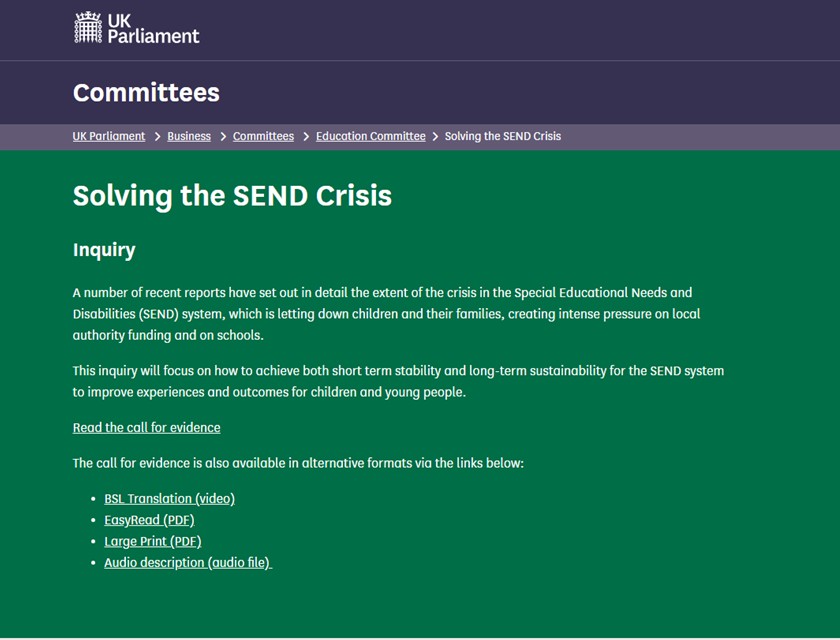
Below I have copied my response sent to the UK Parliamentary Select Committee seeking evidence to improve ‘the SEND system’.
In response to your Select Committee’s ‘Call for evidence on ‘actions to stabilise the SEND system’, below I offer evidence directly focused on the issue of ‘inclusivity’ for SEND children and young people, across both special and mainstream education provision.
This issue of inclusivity in particular addresses two of the key inquiry questions asked by the select committee within the section: ‘Support for children and young people with SEND’. These are:
1. Outcomes for children and young people with SEND and how these can be improved?
2. What substantive training is needed for teachers, teaching assistants and all those who work with children with SEND to improve knowledge of SEND and pedagogical approaches to teaching SEND children to increase their inclusion in schools?
Focusing firstly on ‘Outcomes for children and young people with SEND and how these can be improved’: the greater use of Intensive Interaction (as initially set out by Professor Melanie Nind & Dr Dave Hewett OBE: 1988, 1994, 1996) to enable children and young people with communication difficulties and differences (most usually children and young people with varying levels of learning difficulties and/or autism) to socially connect with teaching and support staff should be an approach that is made available to all children encountering such difficulties.
Below I will set out the research evidence base showing the improved social communication outcomes that are vitally important in creating an inclusive teaching/learning environment that can support and sustain fundamental communication learning, and therefore natural development.
The ‘observable’ outcomes of Intensive Interaction
For over 30 years research into Intensive Interaction has routinely evidenced a number of common socially beneficial outcomes, these being of increased or novel socially interactive responsiveness on the part of the child or adult recipients (with such recipients most often being children and adults with learning difficulties and/or autism).
Listed below are the most common observable and therefore directly measurable interactive outcomes associated with the use of Intensive Interaction with both children and adults with communication difficulties and differences, as compared to initial or baseline measures:
- Increased social anticipation, initiation and/or engagement (… and of more complexity)
As evidenced in the following studies: Nind, 1996; Watson & Fisher, 1997; Kellett, 2000; Cameron & Bell, 2001; Kellett, 2003; Kellett, 2004; Forster & Taylor, 2006; Anderson, 2006; Barber, 2008; Samuel et al, 2008; Zeedyk et al, 2009a; Zeedyk et al, 2009b; Jones & Howley, 2010; Fraser, 2011; Argyropoulou & Papoudi, 2012; Harris & Wolverson, 2014; Rayner et al, 2014; Calveley, 2017; Karimi et al, 2019; McKim & Samuel, 2020; Mourière & Hewett, 2021; Glass et al, 2024.
- Improved levels of joint attention
As evidenced in the following studies: Nind, 1996; Lovell et al, 1998; Kellett, 2000; Kellett, 2003; Kellett, 2004; Kellett, 2005; Leaning & Watson, 2006; Samuel et al, 2008; Mourière & Scott-Roberts, 2017; Mourière & Hewett, 2021; Glass et al, 2024.
- Increased use of vocalisations
As evidenced in the following studies: Watson & Knight, 1991; Lovell et al, 1998; Kellett, 2000; Elgie & Maguire, 2001; Cameron & Bell, 2001; Argyropoulou & Papoudi, 2012; Harris & Wolverson, 2014; Calveley, 2017; Mourière & Scott-Roberts, 2017; McKim & Samuel, 2020; Mourière & Hewett, 2021.
- Increased levels of eye contact (or looking at another’s face)
As evidenced in the following studies: Watson & Knight, 1991; Nind, 1996; Lovell et al, 1998; Kellett, 2000; Kellett, 2004; Cameron & Bell, 2001; Kellett, 2003; Kellett, 2004; Kellett, 2005; Leaning & Watson, 2006; Forster & Taylor, 2006; Barber, 2008; Samuel et al, 2008; Zeedyk et al, 2009a; Zeedyk et al, 2009b; Fraser, 2011; Argyropoulou & Papoudi, 2012; Harris & Wolverson, 2014; Mourière & Scott-Roberts, 2017; McKim & Samuel, 2020; Berridge & Hutchinson, 2021; Mourière & Hewett, 2021.
- Increased toleration of, or responsiveness to physical proximity
As evidenced in the following studies: Nind, 1996; Firth et al, 2008; Zeedyk et al, 2009a; Zeedyk et al, 2009b; Fraser, 2011; Harris & Wolverson, 2014; Calveley, 2017; Berridge & Hutchinson, 2021.
- Increased levels of contingent smiling
As evidenced in the studies: Nind, 1996; Lovell et al, 1998; Leaning & Watson, 2006; Barber, 2008; Zeedyk et al, 2009a; Argyropoulou & Papoudi, 2012; Calveley, 2017; McKim & Samuel, 2020.
- Increased levels of socially significant physical contact
As evidenced in the following studies: Lovell et al, 1998; Kellett, 2000; Elgie & Maguire, 2001; Kellett, 2003; Kellett, 2004; Forster & Taylor, 2006; Firth et al, 2008; Barber, 2008; Samuel et al, 2008; Argyropoulou & Papoudi, 2012; Harris & Wolverson, 2014; Calveley, 2017; McKim & Samuel, 2020.
The rate of change in social interactivity associated with the use of Intensive Interaction – and what this means in terms of developmental progression
These commonly evidenced prosocial ‘interactive outcomes’ (as listed above i.e. increases in different aspects of fundamental communication) are seen to vary in how quickly, or more gradually, such changes are reported to occur. The research findings of increased or novel socially interactive responses by the child (and/or adult) participants in Intensive Interaction research fall into two separate timescales: one seemingly quite rapid, the other relatively more gradual (but also seemingly more continuous) over a longer period.
The research evidencing gradual and more continuous improvements in interactive responsiveness was carried out over many months or across several academic terms (e.g. in research carried out in schools), whilst other studies capturing evidence of more rapid increases in sociability were conducted over much shorter periods e.g. across weeks, and sometimes even days (e.g. Lovell et al, 1998). Indeed, instances of sometimes very rapid changes in the levels of social engagement are often anecdotally related by practitioners using Intensive Interaction techniques with people; sometimes for the very first time!
As Firth (2008) describes in the paper ‘The Dual Aspect Process Model of Intensive Interaction’, there appear to be two different but co-dependent processes at work with Intensive Interaction. Firstly there is one primarily focused on enacting a child or person-centred ‘social inclusion process‘ (Firth, ibid) that is initially co-constructed with the recipient child or adult with communication difficulties and/or differences. Subsequently (i.e. dependent on the success of that initial social inclusion process) there is another more gradual process that is seen as a ‘developmental aspect’ that emerges cumulatively over the longer term, where novel or increased social understandings and capabilities continue to be further developed in a more sustained manner.
In support of such a ‘dual aspect process model’ within the research body, claims of such a rapid ‘social inclusion process‘ comes from a number of the shorter-term research studies e.g. Lovell et al, 1998; Zeedyk et al, 2009a; Zeedyk et al, 2009b; Argyropoulou, & Papoudi, 2012; Harris & Wolverson, 2014. Indeed, in a study using ‘micro-analytic analysis’ of Intensive Interaction (Zeedyk et al, 2009b), it was shown that for all the participants Intensive Interaction was: ‘… effective in promoted social engagement … well before the end of the first full intervention session’, with some changes being seen ‘to occur within minutes’.
In addition to the potential for these very rapid increases in social responsiveness (attributable to the ‘social inclusion process’ enabled by Intensive Interaction), the sustained use of the approach over longer periods described as the ‘developmental aspect’ (Firth, ibid) is also strongly evidenced across a number of studies.
Such extended or systematic use of Intensive Interaction evidencing longer-term, cumulative developmental outcomes (of improved social understanding and engagement) is reported on in a number of papers including: Watson & Knight, 1991; Watson & Fisher, 1997; Nind, 1996; Kellett, 2000; Kellett, 2003; Kellett, 2004; Jones & Howley, 2010; Fraser, 2011; Calveley, 2017; Mourière & Scott-Roberts, 2017; Karimi et al, 2019; McKim & Samuel, 2020; Mourière & Hewett, 2021.
Therefore, when identifying social communication and engagement issues for children in schools (i.e. and as often stated in their EHCPs – which increasingly include Intensive Interaction as means of meeting an identified need for individual SEND children), then Intensive Interaction needs to be made available to all the children who struggle with this aspect of their social engagement, learning and development.
To address the second question asked by the committee and identified above i.e. What substantive training is needed for teachers, teaching assistants and all those who work with children with SEND to improve knowledge of SEND and pedagogical approaches to teaching SEND Children to increase their inclusion in schools? Then obviously teachers, teaching assistants and all those who work with and/or support children with SEND who have communication difficulties and differences (due to their autism and/or learning difficulties) need to know about, and be able to confidently and consistently practice, Intensive Interaction.
Therefore, high-quality training and support in the use of the Intensive Interaction approach should be made available, and possibly even mandatory, for all SEND staff.
Graham Firth
Intensive Interaction Institute – Lead for Research and Publications
https://www.intensiveinteraction.org/
https://connectingwithintensiveinteraction.com/
Reference List:
Anderson, C. (2006) ‘Early Communication strategies: using video analysis to support teachers working with preverbal pupils’, British Journal of Special Education, 33(3), 114-120.
Argyropoulou, Z. & Papoudi, D. (2012) ‘The training of a child with autism in a Greek preschool inclusive class through intensive interaction: a case study’, European Journal of Special Needs Education, 27 (1), 99-114.
Barber, M. (2008) ‘Using Intensive Interaction to add to the palette of interactive possibilities in teacher-pupil communication’, European Journal of Special Needs Education, 23 (4), 393-402.
Berridge, S. & Hutchinson, N. (2021) ‘Mothers’ Experience of Intensive Interaction’
Journal of Intellectual Disabilities, 26(2), 391–406.
Calveley, J. (2017) ‘Gaining the power of initiation through Intensive Interaction’, Learning Disability Practice, 20(1), 19-23.
Cameron, L. & Bell, D. (2001) ‘Enhanced Interaction Training’, Working with People who have a Learning Disability, 18 (3), 8-15.
Elgie, S. & Maguire, N. (2001) ‘Intensive Interaction with a Woman with Multiple and Profound Disabilities: a case study’, Tizard Learning Disability Review, 6 (3), 18-24.
Firth, G., Elford, H., Leeming, C. & Crabbe, M. (2008) ‘Intensive Interaction as a Novel Approach in Social Care: Care staff’s views on the practice change process’, Journal of Applied Research in Intellectual Disabilities, 21, 58–69
Firth, G. (2008) ‘A Dual Aspect Process Model of Intensive Interaction’, British Journal of Learning Disabilities, 37(1), 43-49.
Fraser, C. (2011) ‘Can adults on the autism spectrum be affected positively by the use of intensive interaction in supported living services?’, Good Autism Practice, 12 (2), 37-42.
Forster, S. & Taylor, M. (2006) ‘Using Intensive Interaction – A case study’, Acquiring Knowledge in Speech, Language & Hearing, 8 (1), 12-15.
Glass, D. & Yuill, N. (2024) ‘Evidence of mutual non-verbal synchrony in learners with severe learning disability and autism, and their support workers: a motion energy analysis study’, Frontiers in Integrative Neuroscience. DOI: 10.3389/fnint.2024.1353966.
Harris, C. & Wolverson, E. (2014) ‘Intensive Interaction: to build fulfilling relationships’, Journal of Dementia Care, 22 (6), 27-30.
Hewett, D. & Nind, M. (1996) Interaction in Action: Reflections on the use of Intensive Interaction. Davis Fulton Publishers.
Jones, K. & Howley, M. (2010) ‘An investigation into an interaction programme for children on the autism spectrum: outcomes for children, perceptions of schools and a model for training’, Journal of Research in Special Education Needs, 10 (2), 115-123.
Karimi, S., Asgari, P. & Heydari, A. (2019) ‘The Effect of Intensive Interaction Intervention on the Social Interactions and Communication of Children with Autism Spectrum Disorder’, Journal of Jondishapour Medicine, 18(6), 603-614.
Kellett, M. (2000) ‘Sam’s Story: evaluating intensive interaction in terms of its effect on the social and communicative ability of a young child with severe learning difficulties’,
Support for Learning, 15 (4), 165 – 171.
Kellett, M. (2003) ‘Jacob’s journey: developing sociability and communication in a young boy with severe and complex learning disabilities using the Intensive Interaction teaching approach’, Journal of Research in Special Educational Needs, 3(1), 18–34.
Kellett, M. (2004) ‘Intensive Interaction in the inclusive classroom: using interactive pedagogy to connect with students who are hardest to reach’, Westminster Studies in Education, 27 (2), 175-188.
Kellett, M. (2005) ‘Catherine’s Legacy: social communication development for individuals with profound learning difficulties and fragile life expectancies’, British Journal of Special Education, 32 (3), 116 – 121.
Leaning, B. & Watson T. (2006) ‘From the Inside Looking Out [FILO] – an Intensive Interaction group for people with profound and multiple learning disabilities’, British Journal of Learning Disabilities, 34, 103-109.
Lovell, D., Jones, S. & Ephraim, G. (1998) ‘The Effect of Intensive Interaction on the Sociability of a Man with Severe Intellectual Disabilities’, International Journal of Practical Approaches to Disability, 22 (2/3), 3-8.
McKim, J. & Samuel, J. (2020) ‘The use of Intensive Interaction within a positive behavioural support framework’, British Journal of Learning Disabilities, 49(2), 129–137.
Mourière, A. & Hewett, D. (2021) ‘Autism, Intensive Interaction, and the Development of Non-Verbal Communication in a Teenager Diagnosed with PDD-NOS: A Case Study’, Support for Learning, 36(3), 400-420.
Mourière, A. & Scott-Roberts, S. (2017) ‘Measuring the impact of Intensive Interaction on joint attention and intentional communication: using the FOCAL wheels’, Good Autism Practice, 18 (1), 24-45.
Nind, M. (1996) ‘Efficacy of Intensive Interaction: Developing sociability and communication in people with severe and complex learning difficulties using an approach based on caregiver- infant interaction’, European Journal of Special Educational Needs, 11 (1), 48-66.
Nind, M. & Hewett, D. (1988) ‘Interaction as Curriculum’, British Journal of Special Education, 15(2), 55-57.
Nind, M. & Hewett, D. (1994) Access to Communication: Developing basic communications with people with severe learning difficulties. David Fulton Publishers.
Rayner, K., Bradley, S., Johnson, G., Mrozik, J., Appiah, A. & Nagra, M. (2014) ‘Teaching Intensive interaction to paid carers: using the ‘communities of practice’ model to inform training’, British Journal of Learning Disabilities, DOI:10.1111/bld.12111.
Samuel, J., Nind, M., Volans, A. and Scriven, I. (2008) ‘An evaluation of Intensive Interaction in community living settings for adults with profound intellectual disabilities’, Journal of Intellectual Disabilities, 12 (2), 111-126.
Watson, J. & Fisher, A. (1997) ‘Evaluating the Effectiveness of Intensive Interaction Teaching with Pupils with Profound and Complex Learning Disabilities’, British Journal of Special Education, 24 (2), 80-87.
Watson, J. & Knight, C. (1991) ‘An evaluation of Intensive Interactive teaching with pupils
with very severe learning difficulties’, Child Language Teaching and Therapy, 7 (3), 310-25.
Zeedyk, M., Davies, C., Parry, S. & Caldwell, P. (2009) ‘Fostering Social Engagement in Romanian Children with Communicative Impairments: Reflections by newly trained practitioners on the use of Intensive Interaction’, British Journal of Learning Disabilities, 37 (3), 186-196.
Zeedyk, S, Caldwell, P. & Davies, C. (2009) ‘How Rapidly Does Intensive Interaction Promote Social Engagement for Adults with Profound Learning Disabilities?’, European Journal of Special Needs Education, 24 (2), 119-137.
 Connecting with Intensive Interaction
Good for you mate. I think it’s a bit light on the training of teacher etc. I realise you don’t want to make it an advert for training, but some level detachment has to happen to change the Institute monopoly . . That’ ll be some carefully written text that somehow synthesises what’s already been written ( not sure it can be written…or at least ‘would be read’…..hence the podcasts)
Get Outlook for Androidhttps://aka.ms/AAb9ysg
LikeLike