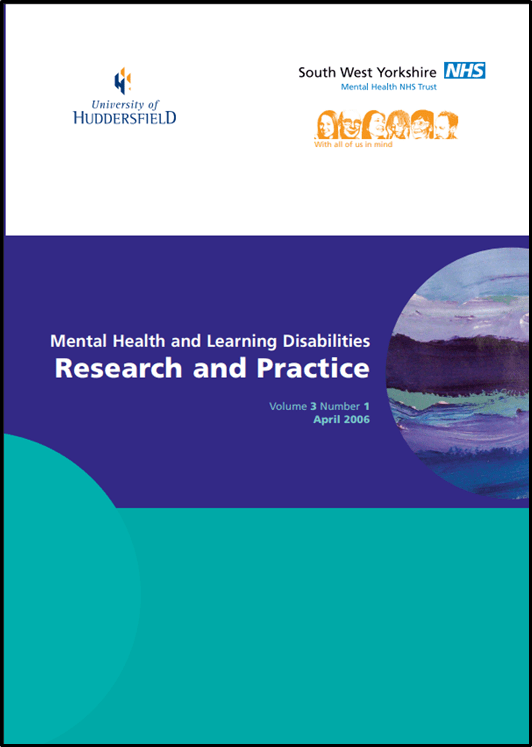
This year (2026), it is 20 years since my first academic/research paper was published. It was a review of the then-current body of research into Intensive Interaction, and so I gave it the imaginative title of: ‘Intensive Interaction: a Research Review‘ (2006; Mental Health and Learning Disabilities Research and Practice, 3(1):53-62). It was in this paper that I first identified the ‘dual aspect process model’ of Intensive Interaction that I expanded on in my (again imaginatively titled) paper ‘A Dual Aspect Process Model of Intensive Interaction‘ (2009; British Journal of Learning Disabilities, 37(1): 43-49).
So, I decided to re-read it, and I found it interesting that since 2005 when I looked at 6 published research papers and now … 20 years later with around 20 more published papers reporting directly on the outcomes of Intensive Interaction, I don’t think the conclusions that I drew then have really shifted that much … well, certainly not enough, not yet.
Below, I will give you a flavour of my conclusions:
~ The body of evidence arising from the research papers reviewed was consistently supportive of claims of increased social responses associated with the onset of Intensive Interaction.
~ There were repeated claims of novel or increased socially interactive behaviours e.g. through greater initiation of social interactivity; greater use of eye contact; increased engagement in physical contact activities; more sustained joint attention; increased use of communicative vocalisations; and an increased regard for facial signalling. There was also evidence of greater initiation of social interaction by some of the research participants.
~ It could be argued that the body of evidence is still limited in its generalisability due to the methodologies employed, i.e. the use of small-scale or single case studies across limited timescales, without experimental controls.
~ The research was conducted by a relatively small number of practitioners and advocates of the approach, raising the issue of unintentional bias in the operationalisation and reporting of studies closely tied to the researchers’ own professional endeavours.
~ And finally, in times which increasingly focus on and value evidence-based practice, further empirical research must take place to build on the already emergent body of evidence.
Since then, there have been a couple of systematic reviews into the body of evidence for Intensive Interaction: Nick Hutchinson and Anna Bodicoat’s 2015 paper ‘The Effectiveness of Intensive Interaction: A Systematic Literature Review‘ (Journal of Applied Research in Intellectual Disabilities, 28: 437–454) which looked at 15 quantitative and 3 qualitative papers, and most recently Papadopoulos et al’s 2023 open-access paper ‘Intensive Interaction as an intervention approach in children with autism spectrum disorder: a systematic review‘ (Neuroscience Research Notes, Vol. 6, No. 4.) which can be downlaod at: View of Intensive Interaction as an intervention approach in children with autism spectrum disorder: a systematic review. This review examined four papers in depth, while also acknowledging many others focusing on research with child participants.
From the 2015 paper, the authors conclude that: ‘Unfortunately, the limitations of the methodology and design of the studies, along with the small numbers of participants, prevent any conclusions from being made regarding the effects of Intensive Interaction‘ (p.451).
From the abstract of the 2023 paper, the authors conclude that: ‘The findings from the studies indicated that children with ASD had a positive outcome from the involvement in the Intensive Interaction approach. Regrettably, the constraints imposed by the methodology and design employed in the studies, coupled with the limited sample sizes (two of the studies consisted of a single case), preclude forming any definitive conclusions about the impacts of Intensive Interaction’.
So what next for 2026 and beyond?
Well, I think it would be fair to say that the evidential base for Intensive Interaction is … yes, unambiguously, year on year, increasingly supportive of the claims made by its practitioners and advocates – but as the 2023 paper points out, the bar for ‘definitive conclusions’ to be drawn from research is (rightly) very high.
This means that, 20 years after my research review, research into Intensive Interaction still needs more studies and more published papers (ideally with larger cohorts) to more fully establish the ‘definitive conclusions about the impacts of Intensive Interaction‘ – and the vital communicative, social and emotional outcomes we as practitioners know are definitively the result of using Intensive Interaction!
 Connecting with Intensive Interaction
In response to your imaginatively worded question it would appear that the answer is No. I realise that my response is of absolutely no use, other than confirmation that I always enjoy reading your blog 😉
LikeLiked by 1 person