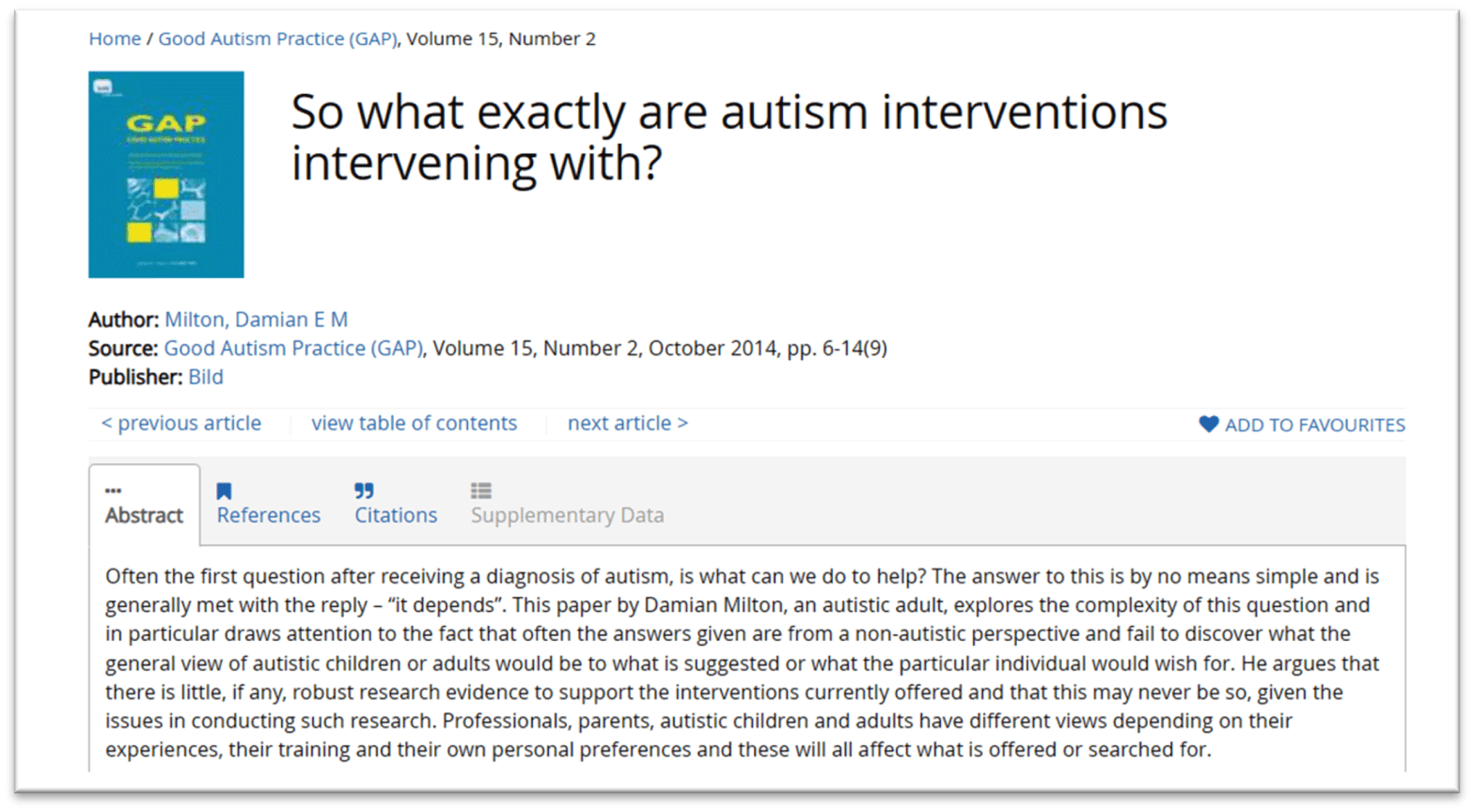
I was recently pointed to a paper by Dr Damian Milton: ‘So what exactly are autism interventions intervening with?‘ (2014, Good Autism Practice, 15 (2), 6-14) which set out the author’s thinking on that very issue. Dr Milton is a much-published university lecturer and has worked as a consultant for the UK National Autistic Society as an ‘autism knowledge and expertise consultant’.
Dr Milton’s work is grounded in the social model of disability, and his work is becoming increasingly influential in current thinking and publication in the field of autism studies. He is probably best known for his “double empathy problem” theory (2012) which defines the social difficulties encountered by autistic people as being socially constructed i.e. that the social engagement ‘problem’ is not caused by autistic people innately or inherently lacking in empathy, but rather comes about because autistic and non-autistic people both struggle with being mutually empathetic, thus causing difficulties in social engagement and communication between people from the two groups.
Anyway, back to Dr Milton’s ‘editorial comment’ paper from Good Autism Practice, in which he sets out to answer the question: ‘Often the first question after receiving a diagnosis of autism, is what can we do to help?’. He argues ‘that there is little, if any, robust research evidence to support the interventions currently offered and that this may never be so, given the issues in conducting such research’. However, he then goes on to review what he calls ‘a number of currently popular practices’ which include Applied Behavioral Analysis (ABA), Relationship Development Intervention (RDI), and Intensive Interaction.
Without referencing too much of the paper here, he does say that Intensive Interaction ‘… is a relationship-based model, which seeks to make functional gains in communication. However, the focus here [with Intensive Interaction] is primarily building trust and rapport on the child’s own terms. This approach is the one that I personally favour …’. (p.10)
He then adds ‘Perhaps with its model of mutual respect in interactions, engaging with autistic interests, and taking into account autistic cognition and sensory differences, it is little wonder that I find intensive interaction the most favourable of current approaches for children on the autism spectrum.’ (p.11)
In his concluding remarks, Dr Milton again asks a question: ‘what is a parent
or practitioner working with autistic children to do?‘ whilst admitting that ‘The answer to this question is never an easy one‘. However, then points the reader to a quote from Richard Mills (formerly Director of Research at the National Autistic Society) who says:
“We need to see the world from the autistic perspective and apply approaches based on a
mutuality of understanding that are rational and ethical – which respect the right of the individual to be different – yet recognises and deals with distress and offers practical help. We should encourage and motivate the person to develop strengths rather than focus on ‘deficits’. This will mean offering opportunity for development while supporting emotional stability.” (Mills, 2013*)
… which I think corresponds exactly with the person-centred philosophy of Intensive Interaction. Indeed, with Intensive Interaction we do not seek to change a person, but instead to offer opportunities for development through mutual understanding, equitable social engagement, and supportive psychological connection.
As a number of us from the Intensive Interaction Institute agreed just last weekend:
‘The aim of Intensive Interaction is not to make an individual more neurotypical, to
change them or to achieve compliance, but to connect; to meet in a mutually comfortable
space that values both communicators and addresses the power imbalance caused by
different communication styles’.
I couldn’t have put it better myself!
Milton, D. ( 2012) ‘On the ontological status of autism: the ‘double empathy problem”, Disability & Society, 27 (6), 883–887.
*Mills, R. (2013) ‘Guidance for considering a treatment approach in autism’ available from: http://www.autism.org.uk/living-with-autism/strategies-and-approaches/before-choosing-an-approach/guidance-for-considering-a-treatment-approach-in-autism.aspx
 Connecting with Intensive Interaction