
With the imminent arrival of a new book on Intensive Interaction (Integrating Intensive Interaction Principles into Psychological Practice, by Dr Sophie Doswell & Dr Maggie Ellis (Eds) (2025), Routledge) for this Blog, I am setting out in chronological order the current range of books published so far (in English) on the approach.
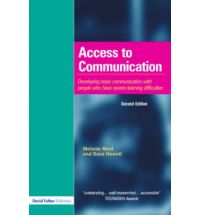
Access to Communication: Developing the Basics of Communication for People with Severe Learning Difficulties, by Melanie Nind and Dave Hewett (1994; 2nd edition 2005), David Fulton Publishers.
Melanie Nind and Dave Hewitt are the pioneers of Intensive Interaction and the leading experts in the field. This, their first book, sets out a clear conceptual framework for understanding Intensive Interaction. The book also addresses the wider theoretical issues that are important in developing a rounded understanding of the approach, whilst giving practical advice on how to do Intensive Interaction. Also covered are some wider issues related to approach adoption, with 10 short case studies included as illustrations.
A Review: ‘If you only read one book about people with learning difficulties this year, read this one… [it] offers a hugely rich and detailed analysis of practice. The pages are full of illustrative case studies and descriptions of interactive sequences. This book will surely reward you with new insights into the people with whom you work and your interactions with them.’ PMLD Link

Interaction in Action: Reflections on the Use of Intensive Interaction, by Dave Hewett and Melanie Nind (Eds,1998), David Fulton Publishers.
This book clarifies the purpose and practical applications of Intensive Interaction. It includes nine chapters by both parents and staff on their day-to-day work with people with severe and complex learning difficulties. The authors restate the underlying principles of the approach and the techniques and practical applications.
Included are chapters where Hewett and Nind address the issues that arise from these accounts, whilst also considering future developments for the approach.
A Review: ‘A great special education resource. The underlining philosophies of Intensive Interaction are for me the most important aspect of working with those with profound learning difficulties.’ Antony Morris, Amazon Customer.
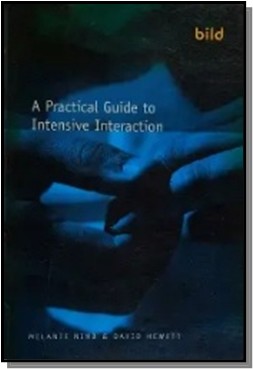
A Practical Guide to Intensive Interaction, by Melanie Nind and Dave Hewett (2001), British Institute of Learning Disabilities.
Written by the originators of the Intensive Interaction approach, this highly accessible book serves as an introductory manual for using Intensive Interaction. The guide aims to enhance communication and social interaction, supporting early intervention and improving the quality of life for individuals with communication difficulties and disabilities. The guide includes numerous case studies and examples illustrating the approach in real-life settings, and offers step-by-step advice, troubleshooting tips, and checklists, making it accessible for readers with varying levels of experience.
This practical guide is intended for a broad audience including: direct care staff, such as classroom assistants and teachers; families and other carers of people with severe or profound and multiple learning difficulties and/or autism.
A Review: ‘Fabulous book, it lays out the foundations of Intensive Interaction, how to practice techniques, record and reflects on observations made. Well worth the read.’ Tigger, Amazon Customer.

Implementing Intensive Interaction in Schools: Guidance for Practitioners, Managers, and Coordinators, by Mary Kellett & Melanie Nind (2003), David Fulton Publishers.
The book includes a clear explanation of Intensive Interaction, with a brief history of its origins and a list of key features. There is an overview of the theory underpinning the approach, some conceptual frameworks that help define the approach and some practical guidance for implementation.
Also included are six case studies, some implementation strategies for promoting student progress, and an outline as to how Intensive Interaction can work within the guidelines of the English National Curriculum.
The book is aimed at those practitioners, coordinators and managers within an educational setting who are already familiar with Intensive Interaction and who require more information to support and develop their practice.
A Review: ‘A really good resource for both professionals and parents (regardless of title). Melanie Nind is a classic and her pioneering works on Intensive Interaction has been invaluable.’ Antony Morris, Amazon Customer.
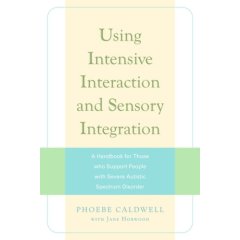
Using Intensive Interaction and Sensory Integration: A Handbook for Those who Support People with Severe Autistic Spectrum Disorder, by Phoebe Caldwell with Jane Horwood (2008), Jessica Kingsley Publishers.
From the publishers: People with severe autism experience the sensory information they receive from the world completely differently to those not on the spectrum. They feel cut off and overwhelmed, and their behaviour can become very distressed. This handbook shows how we can engage with people who are non-verbal or semi-verbal and sometimes even those who have speech but lose the power to process it when they are in crisis. We can help them to make sense of the world. With illustrations, case examples and a wide range of tried-and-tested techniques, this practical guide provides indispensable tools for parents, carers and other professionals supporting people with severe autism and other learning disabilities.
A Review: ‘Highly recommended for people who want to get a better understanding of how people within the autistic spectrum feel, how to communicate with very autistic people, and how to help make their life easier. Some technical language but very clearly explained, including practical examples from the author’s long experience.’ Eva Sanchez, Amazon customer.

Understanding Intensive Interaction: Context and Concepts for Professionals and Families, by Graham Firth, Ruth Berry & Cath Irvine (2010), Jessica Kingsley Publishers.
From the Publishers: this book ‘… will help families and professionals develop a deeper understanding of this highly successful approach and its associated issues, resulting in improved communication opportunities within a variety of care, therapeutic and educational settings. This compendium offers a multidisciplinary perspective to Intensive Interaction, bringing together the authors’ experience and research from different disciplines. Each chapter is devoted to an overarching concept – including psychological theories of human behaviour, relationship building and maintenance and social inclusion – and illustrated with case studies to support theoretical assertions and offer practical examples of useful techniques.’
A Review: ‘It is a concise, accessible and very readable introduction to a lot of related issues. The authors take it in turns to write chapters, and the varied voices behind the text keep the experience of reading it engaging and personal. It was the sort of book that I found hard to put down, but I made myself read slowly as it brought up so many thoughts and ideas on every page. As an introduction to related concepts, it is excellent, and it has sent me off in a variety of different directions to read other books, papers and articles.’ Jules McKim, Amazon Customer.
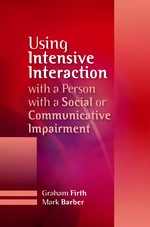
Using Intensive Interaction with a Person with a Social or Communicative Impairment, by Graham Firth and Mark Barber (2010), Jessica Kingsley Publishers.
From the Publishers: This easy-to-use guide steers readers through the practical application of the approach, showing how positive results can best be achieved. The authors explain clearly how to prepare for, carry out and reflect on the use of Intensive Interaction with a client or family member.
A multitude of key questions are addressed, including finding the right setting, evaluating progress and disengaging effectively at the end of a session. In the final section, they consider some of the wider implications of the approach, such as developing confidence as a practitioner and incorporating Intensive Interaction into long-term care or educational planning.
A Review: ‘This excellent book is a really useful guide for those new to Intensive Interaction, but equally so for more experienced practitioners. It is easy to read, clear and straightforward yet the authors manage to go into intricate detail the nuances of communication between two people… All factors are considered: the environment, time available and the physical and emotional well-being of the person. There are tips for encouraging sustainability of the approach within a workplace, advice for when interactions don’t appear to be working and even some examples of different recording sheets that can be used. Graham and Mark have created a truly comprehensive guide that leaves no stone unturned.’ Liz Pond, Amazon Customer.

The Intensive Interaction Handbook by Dave Hewett, Mark Barber, Graham Firth & Tandy Harrison (2011), Sage Publications (from 2018 in its 2nd edition!)
From the publishers: ‘This book is a practical guide to help those wishing to implement intensive interaction in their setting, and it provides detailed advice and step-by-step guidance as well as a consideration of all the issues associated with carrying out this approach. This book considers: preparing for Intensive Interaction; observing Intensive Interaction in progress; doing Intensive Interaction at home and at work; teamwork; well-being; record-keeping. This book is a straightforward guide for anyone wanting to use Intensive Interaction with people with severe and complex learning difficulties, people who have very severe learning difficulties, profound and multiple learning difficulties, multi-sensory impairments, and people who have a diagnosis of autism.’
A Review: ‘In my experience, Intensive Interaction can make a life-changing difference to those with autism or complex learning difficulties. If you already use Intensive Interaction, this book is an essential reminder of what makes it special – if not, it will inspire you to give it a try!’ Nicky Phillips, Educational Psychologist.

Intensive Interaction: Theoretical Perspectives, Edited by Dave Hewett, (2011), Sage Publications.
From the publishers: ‘… this book provides a comprehensive and detailed description of the theoretical landscape of a now established methodology. The most prominent related theories and issues are reviewed, with Intensive Interaction set within their contexts.
The issues covered include: The approach within education and the curriculum; Intensive Interaction within adult services; Effects on organisational change and development; Neurology and learning outcomes; Intensive Interaction and the central triad of autism; Emotional learning and development outcomes; Adoption of Intensive Interaction.
A Review: ‘This is a very welcome addition to the growing body of literature on Intensive Interaction. By drawing on new findings from neurology and a better understanding of the centrality of communication, it demonstrates the power of Intensive Interaction as a practical intervention for a wide range of practitioners.’ Professor Seamus Hegarty, editor of the European Journal of Special Needs Education.

Intensive Interaction: Learning through Social Connection – How Intensive Interaction can help your child with autism to learn more naturally, by Sara Moroza-James (2014), Thinking Autism.
From the introduction: ‘We were happy with each consultant and we had absolutely wonderful therapists, but gradually, with every programme, it dawned on us that something wasn’t right. Why, if my son was making progress, was he becoming more demand-resistant? Why was he still unhappy, anxious, isolated and obsessive? Why were we, his family, still so stressed and depressed about our relationship with him? Although he was acquiring the skills we were teaching him, in some ways his autism was becoming more severe. How could that be? … We urgently needed to help him.’
Prepared for Thinking Autism by Sara Moroza-James, a mother of a child with autism and Intensive Interaction practitioner and trainer.

Integrating Intensive Interaction: Developing Communication Practice in Services for Children and Adults with Severe Learning Difficulties, Profound and Multiple Learning Difficulties and Autism, by Amandine Mourière and Jules McKim (Eds) (2018), Routledge.
From the publishers: this book features a collection of chapters illustrating the integration of Intensive Interaction practice into schools and adult service settings. It addresses communication development, both from a micro and macro level across a variety of service settings, with each chapter written by a different practitioner. These personal accounts cover individual practice and reflection with a single case-study person, as well as influencing organisational change.
Filled with practical advice and techniques to develop communication with people who find it hard to communicate, as well as guidance on ensuring the sustainable extension of the use of Intensive Interaction by embedding the approach within organisational ways of working, this book will be of value to anyone working within children and adult services for people with communication impairments.
Adaptive Interaction and Dementia: How to Communicate without Speech, by Dr Maggie Ellis and Professor Arlene Astell (2018), Jessica Kingsley Publishers.
From the publishers: ‘This guide to Adaptive Interaction explains how to assess the communication repertoires of people with dementia who can no longer speak and offers practical interventions for those who wish to interact with them.
Outlining the challenges faced by people living with advanced dementia, this book shows how to relieve the strain on relationships between them, their families, and professional caregivers through better, person-centred communication. It includes communication assessment tools and guidance on how to build on the communication repertoire of the individual with dementia using nonverbal means, including imitation, facial expressions, sounds, movement, eye gaze and touch. With accessible evidence and case studies based on the authors’ research, Adaptive Interaction can be used as the basis for developing interactions without words with people living with dementia.’
A Review: ‘At last a book that is written in a way that everyone can understand and use in their daily work. Person-centred and practical, this is something that will without doubt change the lives of people affected by dementia.’ Cathy Baldwin, Organisational Manager (Quality), Alzheimer’s Society.
Delivering Intensive Interaction Across Settings: Practice, Community and Leadership, by Mark Barber and Graham Firth (Eds) (2019), KDP Aus.
Across its 14 chapters, this book contains insightful contributions from a wide range of Intensive Interaction practitioners, Intensive Interaction Coordinators, family members, heads of service, principals and psychologists from Australia, the UK, New Zealand and Denmark.
The various chapters set out descriptions of the practices, strategies and wider contextual and organisational considerations each author has had to apply whilst delivering Intensive Interaction across a range of services and care or educational settings.
A Review: ‘Great book, highly recommended.’ Aileen Mary, Amazon customer.
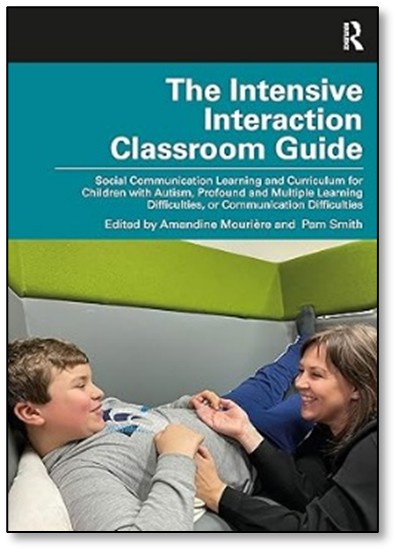
The Intensive Interaction Classroom Guide: Social Communication Learning and Curriculum for Children with Autism, Profound and Multiple Learning Difficulties, or Communication Difficulties, by Amandine Mourière and Pam Smith (Eds), (2021) Routledge.
From the publishers: ‘This book is a practical guide to implementing the Intensive Interaction Approach in a school setting and provides essential technical support to teachers and practitioners from nursery to Post-16 who want to embed it into their classroom practice.
Geared mainly towards supporting children with communication and social-communication difficulties arising from autism or learning difficulties, the principles apply equally to students of all levels of cognitive ability who struggle with social situations and emotional or sensory regulation.’
‘The Intensive Interaction Classroom Guide brings together contributions from experienced teachers, teaching assistants, and headteachers, who reflect on their practice and share practical tips to facilitate social-communication development within a nurturing classroom environment. Offering practical advice on curriculum and pedagogy and drawing on case studies, authors address key themes on a practical level, while grounding their discussions theoretically and methodologically.’
A Review: ‘Embedding Intensive Interaction at the heart of a school’s educational, pastoral and care provision should be seen as a vital element in meeting our children’s special educational needs. This book offers reflective, insightful and practically useful perspectives and resources that can significantly help in this process. Setting each individual child at the very centre of their own social and communicative development is what Intensive Interaction undoubtedly delivers; this book will help schools and teaching staff alike to more effectively meet that challenge.’ Graham Firth, Intensive Interaction Institute Team Leader.
A 2nd Edition of the Intensive Interaction Classroom Guide is now being written for publication in the near future!
And new for 2025:

Integrating Intensive Interaction Principles into Psychological Practice, by Dr Sophie Doswell & Dr Maggie Ellis (Eds) (2025) Routledge.
From the publishers: ‘This book details how to use Intensive Interaction as a psychologically informed practice when working with ‘seldom-heard’ clients. Although Intensive Interaction was originally developed for children with severe and profound learning disability, its use has expanded across age ranges and conditions, and is now utilised with children and adults including autistic individuals and people with dementia.
Exploring the context in which Intensive Interaction has and can be used, specifically as a psychological approach, this edited volume covers therapeutic intervention on a one-to-one basis, as well as an intervention within other frameworks such as Trauma Informed Care and Positive Behaviour Support. Case examples are utilised throughout, alongside psychological theory, to demonstrate use in practice. Consideration is also paid to service contexts and how psychologists can introduce this approach in their local areas.
The first book on Intensive Interaction written by psychologists for psychological practitioners, this book will appeal to trainee and qualified clinical and counselling psychologists, and psychological practitioners including creative therapists and counsellors.’
A Review: ‘Intensive Interaction is one of the most intriguing avenues of therapy for connecting with people seen as otherwise unreachable. The book offers a valuable – and I suspect, heartwarming – collection of papers showing the diversity of experience and practice using this method. Its importance lies also in attempts to frame it theoretically within Psychology, a connection which is valuable for practitioners and non-practitioners alike.’ Vasudevi Reddy, Emeritus Professor, Developmental and Cultural Psychology Centre for Interaction, Development and Diversity, University of Portsmouth, UK.
Integrating Intensive Interaction Principles into Psychological Practice is available for pre-order directly from the publishers on September 30, with copies being shipped from October 21, 2025, onwards.
 Connecting with Intensive Interaction