
“I can’t thank you enough for your input, and I really feel your Intensive Interaction training is going to benefit [person’s name] and the team immeasurably going forward” – Parent
Continuing on from my last Blog on Kate Parker’s report about an Intensive Interaction pilot project (Blog 1 on 15.08.25 – focusing on the project format and development), in this Blog 2, I endeavour to summarise some of the reported outcomes from this project.
‘The Outcomes’ for service users
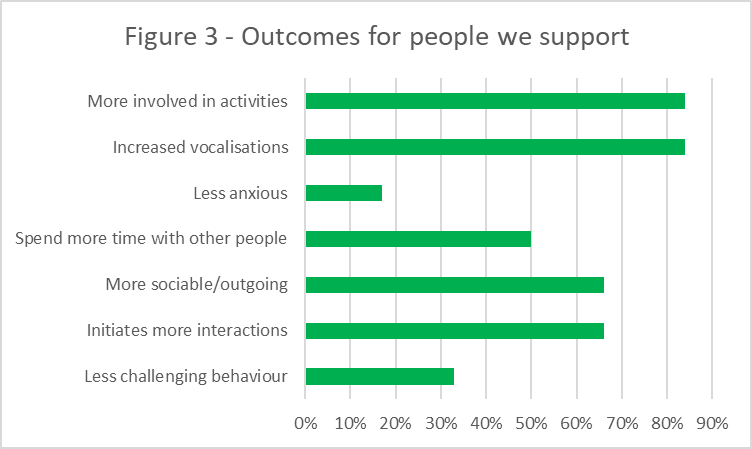
Feedback on the outcomes for service users was provided through a series of follow-up calls and by an online survey. The results showed that in the majority of cases, service users became more actively engaged and more communicative, and for others, there was a significant reduction in anxiety and distressed or challenging behaviours (see Fig.3 ).
Discussion with the Intensive Interaction Champions and other colleagues provided anecdotal feedback about the outcomes of the pilot. Below are some examples:
- The main anecdotal feedback was a reduction in ‘Behaviours of Concern’ (BoC). Staff successfully used Intensive Interaction to help people feel better generally, and also as a way of helping a person calm down when they showed signs of distress.
- A person who rarely engaged with staff, often sending them out of the room, is now turn-taking with staff. He is happy for them to be near him and to join in with his sounds and movements. He is also able to lead staff to what he wants, showing them what he needs, without getting frustrated and potentially hurting people.
- Another person who seemed hard to reach is now comfortable engaging in turn-taking with staff. It has reduced how much time he spends flicking through YouTube. He spends more time engaging with staff instead.
- Another person who was hard to reach would spend up to 10 hours watching cartoons on his iPad, reluctant to do anything else. It was hard for his staff to support him to go out due to his focus on his iPad. Three weeks after the team was trained in Intensive Interaction, the person no longer bothered with their iPad. He spent his time engaging with his staff instead. He goes out more and is happy to do so.
- Staff have been able to build relationships quickly with people new to a service.
- A person we support who only really engaged with one staff member now also has enjoyable exchanges with the rest of the team.
- One person began to initiate hugs with his family.
- One person has increased the number and range of vocalisations they use. They have progressed to using some speech, including telling their mum she is “beautiful”.
‘The Outcomes’ for staff
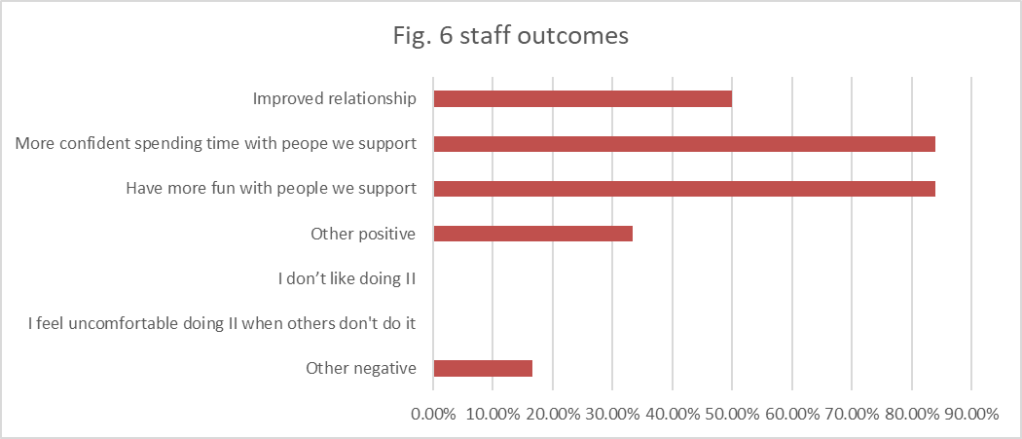
The Intensive Interaction training was tailored to each service, including video of the specific person/people the team supports. Staff feedback gathered after the training indicated that they gained knowledge and confidence in using Intensive Interaction. Also, a follow-up survey 18 months after the start of the pilot showed that colleagues felt that Intensive Interaction had helped them to build relationships with the people they support, and to spend more time, and more enjoyable time, with them (see Fig. 6).
Discussion with the Intensive Interaction Champions and other colleagues provided other anecdotal feedback about the outcomes of the pilot:
- New staff quickly picked up the practice from the Intensive Interaction Champions and observed colleagues who had attended training.
- Staff quickly generalised the approach – i.e. identified other people who would benefit from Intensive Interaction, and then began to use it in their support as well.
- Intensive Interaction helped staff move away from a reliance on words when communicating with people who do not use words.
- The Intensive Interaction resource folder has been useful in coaching new colleagues.
Some other ‘Outcomes’ from the project:
- So far, more than 140 staff members have been trained in Intensive Interaction across 8 services. These have included residential, supported living and day services, with at least 1 Intensive Interaction Champion trained per service.
- Each service has been provided with a resource folder, with an edited, captioned video of the techniques being used with one or more people they support. These videos can be used as reminders of the techniques and to help Champions coach new staff.
- The Intensive Interaction Lead has supported the process of incorporating Intensive Interaction into some people’s support guidelines.
- A presentation was given for Voyage Care’s ‘Being Trauma Informed’ Guide Team – to raise awareness of Intensive Interaction and how it can be used to support people in a ‘Trauma Informed’ way.
And finally, Feedback from Family Members
- “What I saw the staff and yourself doing is in large part the sort of interactions myself and my late wife have done with him throughout his life, so that’s probably why he reacted so well. Now that he’s doing these things with the staff there, he’s getting a continuation of what he gets at home and that’s no bad thing.” – Parent
- “I think it also seems to have greatly empowered the staff team at [name of service]” – Parent
- “These results brought tears to my eyes and a warm satisfaction that [person’s name] has meaningful interactions with his [service name] service users and staff. A big thanks to all involved. Cheers.” – Parent
- “It’s clear the Intensive Interaction you have taught the team is having a massive positive effect on [person’s name]’s behaviour” – Parent
- “I can’t thank you enough for your input, and I really feel your Intensive Interaction training is going to benefit [person’s name] and the team immeasurably going forward” – Parent
If anyone working with, or wishing to lead on, Intensive Interaction in a similar service context wants to contact Kate directly, e.g. to gain more detail on her Intensive Interaction Lead role and experiences, you can contact her at: KateParker@voyagecare.com
 Connecting with Intensive Interaction
One thought on “Intensive Interaction Pilot Project at Voyage Care: Blog 2 – ‘the Outcomes’”