An increasing number of posts have been popping up online recently advocating systems or frameworks for tracking progress in social interactivity; these are often linked with internet searches for Intensive Interaction. Written in collaboration with my colleagues at the Intensive Interaction Institute, this blog encourages reflection on the use, purpose and relevance of such frameworks from an Intensive Interaction perspective.
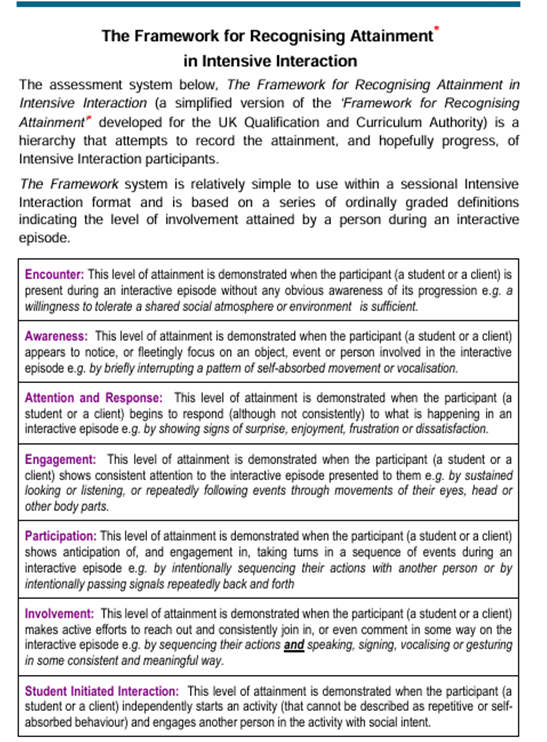
I have written this blog in response to an apparently growing trend in advocating for or advertising systems or frameworks that purport to assign what could best be described as discrete social developmental levels to an individual’s performance during periods of Intensive Interaction. These systems or frameworks all seem to use the same graded definitions indicating a perceived level of engagement of a child or adult participant during an interactive episode.
These ‘levels’ or ‘stages’ are labelled as: Encounter, Awareness, Attention and Response, Engagement, Participation, Involvement, and finally, ‘Initiating Interactions‘ or ‘Student Initiated Interaction‘.
The idea is that, by assigning such ‘levels’ or ‘stages’ to the participant over time, some objective assessment of their social communicative practice (during periods of Intensive Interaction) can be evidenced. Indeed, any sustained change in their reported ‘levels’ or ‘stages’ of engagement could also then be interpreted as evidence of a change in the participant’s general level of interactive engagement over time – hopefully in an increasingly developmentally progressive or positive manner.
I should know this because back in the day, when I was a teacher, I also used this same hierarchy of graded definitions in what I called ‘A Framework for Recognising Attainment in Intensive Interaction’ (I also had some help from my fellow II traveller, Dr Mark Barber – see reference below).
I developed and used it in my classes (for adults with profound and multiple learning difficulties) in an attempt to record the social engagement attainments of the participants (and hopefully any generalised and sustained progress in that domain). I even presented on it at the first-ever Intensive Interaction Conference held at Birmingham University back in 2002.
But I can’t claim much credit really, as my ‘Framework’ was in reality just a simplified version of the ‘Framework for Recognising Attainment’* developed for the Qualification and Curriculum Authority (QCA) and published in their document Planning, teaching and assessing the curriculum for pupils with learning difficulties: General Guidance (2001), based on the the work conducted by a number of people in the 1980s and 1990s.
However, over the years, I have become increasingly less confident in any such system, with increasing doubts in terms of what such a framework actually measures, and whose needs it actually meets.
At the time, I thought that my Framework for Recognising Attainment in Intensive Interaction met my need as a teacher to evidence some kind of positive outcome from my use of Intensive Interaction (and then maybe show this to my senior leadership team). But I’m not sure what discernible need it fulfilled for the learners; actually, I don’t think it did meet their needs in any way – their need was just have Intensive Interaction used with them, not to have their attempts at it with another person (who might or might not be very good at practicing Intensive Interaction) measured in some way for some opaque systemic, professional or managerial purpose.
On further reflection, I now think that any positive movement up the hierarchy of graded levels attributed by us (as the teaching staff) to our learners was almost certainly due to us (as staff) becoming better communication partners for them i.e. getting better at practising Intensive Interaction.
So, not really a measure of them, but instead mainly a measure of us and our increasing ability in successfully socially scaffolding their engagement. This is actually okay, as I now think that it indicates a sustained ‘social inclusion process‘ (Firth, G. 2008 – see image below), but a very different thing to what is, I suggest, generally claimed from the evidence captured by this, or any similar system or framework.

So, I now think that the idea of discrete ‘levels’ or ‘stages’ of Intensive Interaction suggests something that isn’t actually individually attributable. Therefore, I now fear that conceptually it could confuse or even confound the very idea of progress in developing and sustaining sociability, which moves upwards or forwards via what would best be described as a ‘learner-centred’ developmental spiral of socially co-constructed and mutually interconnected skills and understandings (i.e. by mutually building a socially negotiated repertoire in the joint application of the Fundamentals of Communication – Nind & Hewett, 2001).
Interestingly, going back to the original QCA 2001 source material, even they say: “This framework should not be used as a tool to measure hierarchical and linear progress mechanistically from encounter to attainment. It is possible, for example, that pupils’ responses may change from day to day and from experience to experience’ (p.30).
But, having said all that, I do recognise the pressure some professionals are under to show evidence of attainment/learning and progress on the part of their learners or clients. Using a predetermined ‘Framework’ can therefore seem an easy ‘fix’ to that issue. But I now think that it should only be used by those with a full understanding of what it does and doesn’t measure (i.e. not really the learner) – and whose needs it is fulfilling (again, not really the learner’s).
Perhaps, in an imperfect world, using a predetermined and quite crude ‘Framework’ to evidence emergent outcomes (what has interactively happened between the learner and their Intensive Interaction communication partner) is probably better than setting even cruder short-term and narrow targets of vaguely described, individually attributed attainments, and then trying to drive the learner into achieving such abstracted targets.
Yes, perhaps sometimes we have to play to the rules of the current system; although at other times perhaps we should, to some degree, also professionally game the system to fulfil our ultimate educational purpose i.e. meeting the learner’s needs. But if we do, we should only ever do so from a position of the fullest possible understanding.
So finally, and to make things absolutely clear, working as I now do with the Intensive Interaction Institute, we as a collective do not recommend the use of such a crude hierarchically graded framework or system, and nor do we recognise any such distinct ‘levels’ or ‘stages’ of Intensive Interaction on the part of the recipient individual; the attainments associated with developing sociability are much more socially context-dependent and nuanced than that!
For more up-to-date information on practices related to ‘recording progress’ with Intensive Interaction, the reader may wish to consult The Intensive Interaction Classroom Guide (Eds: Mourière, A. & Smith, P. [2022], Routledge).
Note: *Planning, teaching and assessing the curriculum for pupils with learning difficulties: General Guidance (2009) published by the Qualifications & Curriculum Authority based on the work of S. Aitken and M. Buultjens (1992), E. Brown (1996) and J. M. McInness and J. A. Treffry (1982).
References:
Firth, G. & Barber, M. (2011) A Framework for Recognising Attainment in Intensive Interaction. Leeds Mental Health NHS Trust: Leeds.
Firth, G. (2008) ‘A Dual Aspect Process Model of Intensive Interaction’, British Journal of Learning Disabilities, 37(1), p. 43-49.
Mourière, A. & Smith, P. (Eds) (2022) The Intensive Interaction Classroom Guide: social communication learning and curriculum for children with autism, profound and multiple learning difficulties, or communication difficulties. Routledge: London.
Nind, M. & Hewett, D. (2001) A Practical Guide to Intensive Interaction. BILD: Kidderminster.
QCA/DfEE (2001) Planning, teaching and assessing the curriculum for pupils with learning difficulties – General guidelines. QCA/DfEE: London.
 Connecting with Intensive Interaction
[like] Kate Parker reacted to your message:
LikeLike