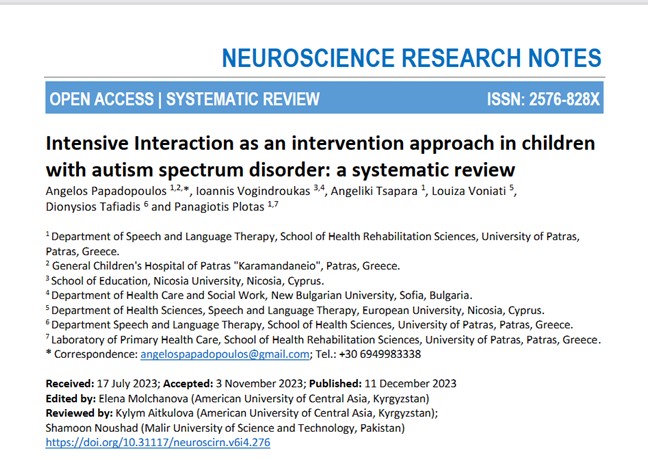
A new Intensive Interaction systemic review has been published by 9 academics working out of universities across Greece, Cyprus and Bulgaria. I have copied the Abstract from the paper by Papadopoulos et al below – but it is available as a complete ‘open access’ publication by the online journal NEUROSCIENCE RESEARCH NOTES.
The Abstract: As a neurodevelopmental condition, autism spectrum disorder (ASD) is characterised by pervasive social interaction and communication deficits. This review aimed to identify and synthesise the latest literature about the effectiveness of the Intensive Interaction approach in children with ASD. The review was conducted according to the PRISMA guidelines. The total number of children with ASD was 28, aged from 4 to 14 years old, with 27 males and only one female. The studies addressed intervention goals related to non-verbal and intentional communication, behavioural difficulties, joint attention, and parent-child interaction.
The findings from the studies indicated that children with ASD had a positive outcome from the involvement in the Intensive Interaction approach. Regrettably, the constraints imposed by the methodology and design employed in the studies, coupled with the limited sample sizes (two of the studies consisted of a single case), preclude forming any definitive conclusions about the impacts of Intensive Interaction. However, the evidence is at least sufficient to support the assertions put forth by the authors.
Despite the encouraging evidence of the effectiveness of the Intensive Interaction approach, multiple factors contribute as barriers to this issue, including the inherent challenges associated with conducting high-quality research that adheres to rigorous methodological standards.
So, as so often is the case, the evidential base for Intensive Interaction is inarguably supportive of the outcome claims made for it by practitioners and advocates – as we know from our personal experience – but as this paper points out, the bar for ‘definitive conclusions’ to be drawn from research is rightly very high. This means that research into our approach still needs more studies and more published papers (ideally with larger cohorts*) to more fully establish ‘any definitive conclusions about the impacts of Intensive Interaction‘.
Let’s hope 2024 brings with it more Intensive Interaction research*!
To read (and download) the full paper, go to: https://www.neuroscirn.org/ojs/index.php/nrnotes/article/view/276/231
Full Reference: Papadopoulos, A., Vogindroukas, I., Tsapara, A., Voniati, L., Tafiadis, D. & Plotas, P. (2023) ‘Intensive Interaction as an intervention approach in children with autism spectrum disorder: a systematic review’, Neuroscience Research Notes, Vol. 6 No. 4 – https://doi.org/10.31117/neuroscirn.v6i4.276.
Note* – there is an ongoing research study into the impact of Intensive Interaction with children with profound and multiple learning difficulties called the ‘INTERACT TRIAL’. For details of this study go to: https://www.interacttrial.com/
 Connecting with Intensive Interaction