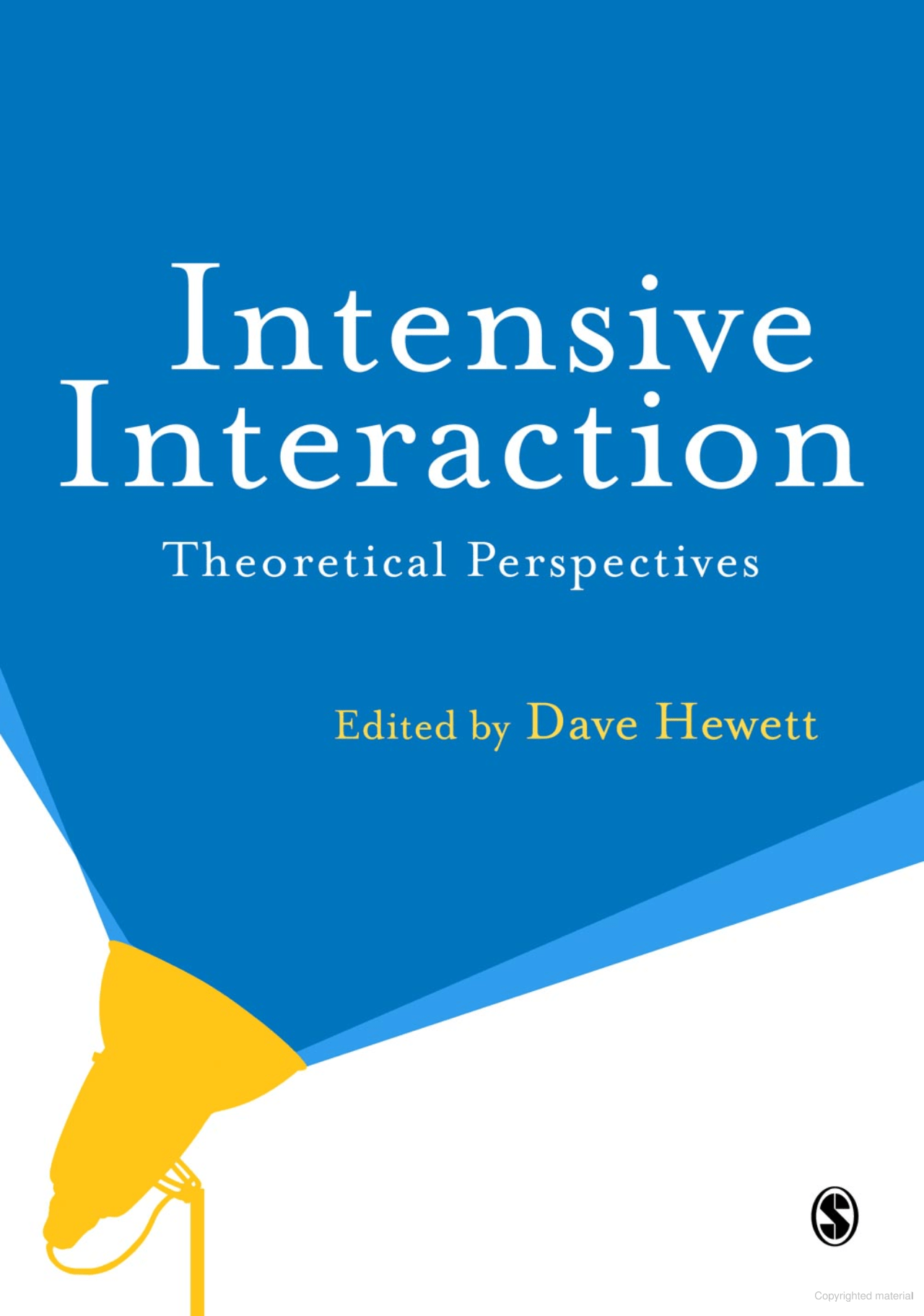
Having presented this week to a group of Care Quality Commission (CQC) inspectors, and trying to get across the vital importance of the taskless, non-functional, ‘hot air’ type chit-chat of human social communication and companionship, I was reminded of Dave Hewett’s chapter in the book Intensive Interaction Theoretical Perspectives (2012) – ‘Blind Frogs: the nature of human communication and Intensive Interaction’,
In this chapter, initially, Dave Hewett describes showing a 4-minute piece by video (with the sound turned off) during Intensive Interaction training courses to stimulate discussion about the nature of human social interactivity. The video shows 5 women who are interacting ‘talking … smiling and laughing a lot, referencing to each other quite excitedly both verbally and non-verbally’. He points out ‘the significance, the profundity, the complexity of the non-verbals; the reading of faces, eyes and body language’. He also points out how each person is demonstrating this profound ability to ‘face and mind read’ the other person ‘enhancing the sense of emotional and psychological connection’.
He states that ‘the greater component of a communication exchange is not the speech, it is the non-verbals, by far’. He then states that these aspects of communication ‘are dealt with by one’s non-consciousness’. He goes on to relate how he asks people what topic the woman on the video are discussing, and no one ever guesses – actually they are being told a story of one of the women finding some eye-less ‘blind frogs’ in the bottom of their garden pond! i.e. it being more-or-less pointless; well actually non-outcome defined, ‘hot air’ type chit-chat!
The function of human communication:
Hewett goes on to discuss the functions of human communication, and asks how much of it is necessary. Indeed, he states that most human communications ‘have no tangible outcome or purpose – nothing concrete happens because of them’. Although, that doesn’t mean that they are unimportant; quite the opposite, instead they ‘fulfil a very deep and rich function for all of us … the hot air of human companionship’. ‘Blind Frog’ type communications ‘include all conversations … that do not have some extrinsic, instrumental, concrete aim or outcome...’ as opposed to those with concrete outcomes (which make up only a minority of human communications).
Hewett then defines a concept of ‘Phatic’ communication, which are ‘communications where what is said is less important than the fact that something is said at all’ and/or ‘conversational speech used to communicate sociability more than information’. He then points the reader to the work of Malinowski (1923) who used the quasi-religious term ‘phatic communion’ to define communications that ‘establish bonds of personal union between people brought together by the mere need of companionship’.
Hewett rhetorically asks about ‘the main source of our internal sense of goodness and well-being?’ and states that it is generally found in the ‘unspoken quality and quantity of our fulfilling relationships and communications with everyone around us’. He also poses the question: ‘what would life be like if your communications were restricted to purely instrumental, goal orientated communications?’
He states that ‘well-being issues’ are not generally affected by instrumental communications and that an imbalance in the types of communications [i.e. not enough ‘Blind Frog’ or ‘the hot air of human companionship‘ type communications] ... will actually be harmful, to all of us, but especially to people who are still at the early stages of development communicatively, psychologically and emotionally’.
How is this way of viewing human communications reflected in our work?
Hewett then introduces a case study of Julie, whose internal state and behaviours were clearly deeply distressed. He reports how a discussion about how to provide Julie with much more frequent ‘Blind Frog’ type communications to improve her psychological state. He also states that in adult services ‘by far the greater proportion of attention given to people with learning difficulties and/or ASD (autism) is likely to be task orientated, goal directed, intended to achieve an instrumental outcome and with the member of staff leading, directing and following a predetermined agenda’.
Hewett also points to the work of John Harris (1994) who stated that ‘standard practices and interaction routines in special school classrooms were more likely to inhibit the development of the pupil’s communication abilities than enhance [them]’. Hewett also states that, other than Intensive Interaction, the other approaches to communication teaching (i.e. PECS, etc) are all focused on teaching goal/task orientated communication (through engaging in goal/task orientated communication), and although this can be a good/useful/proper thing, it should not be done at the expense of Blind Frog-type or Phatic communications that address the issues of companionship, social connectedness and well-being.
Reference:
Hewett, D. (2012) ‘Blind Frogs: the nature of human communication and Intensive Interaction’,chapter in the book’, in Intensive Interaction Theoretical Perspectives (ed Hewett, D.), Sage Publications, London.
Malinowski, B. (1923) ‘The Problem of Meaning in Primitive Languages’, in C. K. Ogden, & I. A. Richards (Eds.), The Meaning of Meaning (pp. 296-336). London: K. Paul, Trend, Trubner.
Harris, J. (1994) ‘Language, Communication and Personal Power: A Developmental Perspective’, in Coupe O’Kane, J. & Smith, B. (Eds), Taking Control: Enabling People with Learning Difficulties, David Fulton: London.
 Connecting with Intensive Interaction