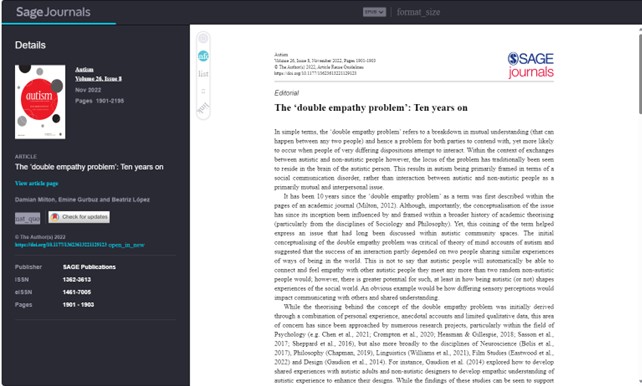
I was recently pointed to an editorial piece in the journal Autism (2022) setting out a decade-on update on Damien Milton’s hugely significant paper: ‘On the ontological status of autism: The ‘double empathy problem’‘ (Disability and Society, 27(3), 883–887). Below I selectively take quotes from this update:
‘In simple terms, the ‘double empathy problem’ refers to a breakdown in mutual understanding … and hence a problem for both parties to contend with… the locus of the problem has traditionally been seen to reside in the brain of the autistic person. This results in autism being primarily framed in terms of a social communication disorder, rather than … as a primarily mutual and interpersonal issue’.
‘The initial conceptualising of the double empathy problem was critical of theory of mind accounts of autism and suggested that the success of an interaction partly depended on two people sharing similar experiences of ways of being in the world‘.
‘… the double empathy problem as initially conceived was heavily influenced by sociological theory and that … social interactions happen within a continually negotiated and mutually constructed context, albeit one infused by unequal power relations’.
‘… an alternative account of autistic development is needed that is not rooted in notions of a social communication disorder, but of a different embodied way of being that can lead to effects on social interactions and understanding’.
‘… the concept of the double empathy problem has the potential to aid a reframing of autism itself from a social communication disorder to a description of a broad range of developmental differences and embodied experiences and how they play out in specific social and cultural contexts. If this were so, it would lead to a radical change to current diagnostic criteria …’
‘Instead of focusing on perceived social deficits and normative remediation, the [double empathy problem] concept suggests a position of humility in the face of difference, the need to build rapport and understanding and not assume a lack of capacity for understanding’.
The reason I am pointing readers to this piece, and previously to the original 2012 ‘Double Empathy Probelm‘ paper (see my Blog of 31.01.22) is because its analytic social constructivist conceptualisation of communication breakdown directly supports the use of the Intensive Interaction approach. Indeed, as Damian Milton himself said in his Good Autism Practice (2014) paper, ‘So what exactly are autism interventions intervening with’:
‘Perhaps with its model of mutual respect in interactions, engaging with autistic interests, and taking into account autistic cognition and sensory differences, it is little wonder that I find Intensive Interaction the most favourable of current approaches for children on the autism spectrum‘ – so there you go!
The original Autism editorial can be viewed in its entirety at: The ‘double empathy problem’: Ten years on – Damian Milton, Emine Gurbuz, Beatriz López, 2022 (sagepub.com)
Refs:
De Jaegher, H. (2021) ‘Seeing and inviting participation in autistic interactions’, Transcultural Psychiatry, 0(0).
Milton, D. ( 2012) ‘On the ontological status of autism: the ‘double empathy problem”, Disability & Society, 27(6), 883–887.
Milton, D. (2014) ‘So what exactly are autism interventions intervening with?’ Good Autism Practice, 15(2), 6-14.
 Connecting with Intensive Interaction
One thought on “The ‘double empathy problem’: Ten years on”