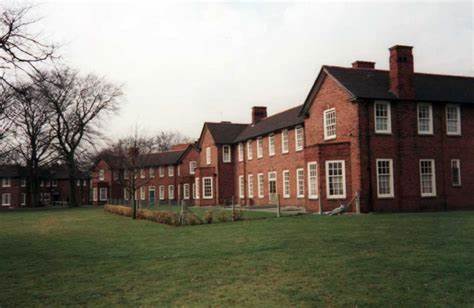
It was about 40 years ago this week that I started working at Meanwood Park Hospital, a ‘Hospital for the Mentally Handicapped’ (prior to that, it was called a ‘mental deficiency colony’) as a Nursing Assistant – that was the medicalised term used to describe us, the unqualified care staff. I had done a bit of voluntary work there during the summer of 1984 when I was at a bit of a loose end professionally (i.e. I was one of the over 3 million unemployed in the UK brought about by the sledgehammer economic ideology of ‘monetarism’), and lacking any real direction or, as far as I can remember, any seeming ambition.
But that all changed when I started full-time work on Villa 17 helping care for, well, let’s see, there was: David, Lawrence, Victor, John, Graham, Melvyn, Winston, another Graham, Paul, Valentine, Alan, Jack, Raymond, another John, Gerald, another Jack, Barry, … and well, there must be around 13 other men whose names are lost to me in the mists of time – sorry gents! It was a 30-bed villa (with only one bathroom… and only one bedroom).
On reflection, what I tried to do to help them in my work was massively outweighed by what they did to help me – both individually and collectively. Through the enjoyment, confidence and sense of purpose I gained working with David and Lawrence (and all the others), it was probably the most formative learning experience of my adult life; in the best possible way.
Actually, not everyone living at Meanwood Park Hospital had an intellectual disability; some people were deaf and difficult to understand verbally, some had severe mental health issues, and some had earlier in their lives engaged in behaviours that challenged the accepted morals of the time. But once in, even as a voluntary resident as the vast majority were, until the idea of community care came along, it was nearly impossible to get out.
Luckily, I initially worked under the tutelage of Sister Maloney – and what a positive experience that was, illustrating what a difference principled, progressive and professional leadership, combined with a collaborative, nurturing, team-working ethos could make … to the benefit of all our lives; an important lesson I have tried to carry forward in all my subsequent work. The then progressive ideas associated with the concept of ‘normalisations’ (see below) and changing from a medicalised care model to ‘community care’ were the guiding principles we worked towards; we felt we were making a positive difference.
There were some difficult times working there, of course there were; shortages of staff (often only 2 staff to support up to 30 men), some behaviours I found challenging (from some staff as well as some residents), or being moved to cover staff shortages on other villas where the culture of care was still full-on, classically institutionalised, with little effort made to create a more humane and homely environment. I can still picture the dayroom of one villa, with its row of chairs, the residents dressed almost identically, unengaged in any meaningful activity. They were therefore driven by their internal need for some level of stimulation, constantly body rocking; backwards and forwards, backwards and forward, on and on and on … perhaps the nearest evidence we can see today to illustrate this kind of care is in the 1981 documentary film ‘Silent Minority’ (which you see part of by following this link).
However, that villa was by then the exception. Elsewhere across the hospital things were changing for the better, and increasing numbers of residents began to move out into community placements. When I left in 1990, whole villas were being closed as the population moved out to smaller, community-based placements and houses. The hospital itself closed in 1996 – but there is a website with some historic details available at: http://www.meanwoodpark.co.uk/ including a somewhat fuzzy film at https://youtu.be/cYcQMpDQeng .
40 years on, the principles of ‘normalisation’ that we were working towards then are still influential in the way that adults with learning difficulties are supported in the UK. These models of normalisation were developed in both Scandinavia and then the USA. Nirje (1969) advocated the need for people with learning difficulties to have ‘patterns of life and conditions of everyday living which are as close as possible to the regular circumstances and ways of life of society‘. The American model of normalisation when renamed as ‘Social Role Valorisation’ by Wolfensberger (1983) was perhaps the most influential here in the UK. Wolfensberger asserted that in order for people to be accorded ‘the good things in life’, such as respect, acceptance and positive relationships, they must hold ‘valued social roles‘. According to Wolfensberger, for adults with learning difficulties, achieving valued social roles involved improving their living conditions, and creating valued social status for them, to minimise the perceived differences between them and other ‘respected’ citizens.
In the 1980s adoption of the normalisation principle was seen as the way forward, and something we on Villa 17 (and subsequently for me also on 14 Field View) certainly bought into. Indeed nationally, normalisation was a powerful philosophical driving force behind the move from caring for people with learning difficulties in large institutions (like Meanwood Park Hospital), to community-supported living in more home-like residential settings.
Interestingly, critiques of the normalisation philosophy began to appear in the late 80s and early 90s. One criticism was that the move of residents from large, often geographically remote ‘mental handicap’ institutions (see my Blog on ‘Remembering Stansfield View’) into community care did not automatically lead to their acceptance by, or participation in a community. Nor did it automatically mean a change in care practices to less ‘institutional’ forms of care. Those criticisms are still often justified today – being placed geographically within a localised community doesn’t on its own make someone a part of that community – genuine social inclusion requires much more than that. And some care and support services can still seem institutionalised and institutionalising for both staff and service users (although nowadays generally with smaller numbers).
Another criticism of the normalisation care philosophy was that the ‘normal’ ideal that people with learning difficulties were expected to strive for was also questioned. It made the assumption that achieving a condition of externally predetermined ‘normality’ was the idealised goal – sometimes with this normalising expectation carrying through into an associated idea of ‘age-appropriateness’ being placed on individuals to restrict their actions or wishes. Thus, the idea of normalisation was seen to place demands on people with learning difficulties to change to fit into society, rather than society change to accept and include them, and acknowledge and value their differences.
However, given all that, a study by Srivastava and Cooke (1999) following up on some of the residents who moved out of Meanwood Park Hospital (into community-based care) found clear evidence that there were multiple benefits. These included apparent ‘increased quality of life‘, ‘increased client capabilities‘ and ‘some improvements in physical and psychological health‘.
So yes, thankfully, that time and that place at Meanwood Park Hospital has now gone … and that was the start of something; but 40 years on, we can still do much better!
References:
Nirje, B. (1969) ‘The normalization principle and its human management implications’. In R. Kugel, & W. Wolfensberger (Eds.), Changing patterns in residential services for the mentally retarded. Washington, D.C.: President’s Committee on Mental Retardation.
Srivastava, A. & Cooke, Z. (1999) ‘Changes in the Quality of Life of People with Learning Disabilities Six Months after Transfer from Long‐Stay Hospital into the Community’, Tizard Learning Disability Review, 4(3), 40-44.
Wolfensberger, W. (1983) ‘Social Role Valorization: a Proposed New Term for the Principle of Normalization’. Mental Retardation, 21(6), 234-239.
 Connecting with Intensive Interaction
One thought on “40 years on…”